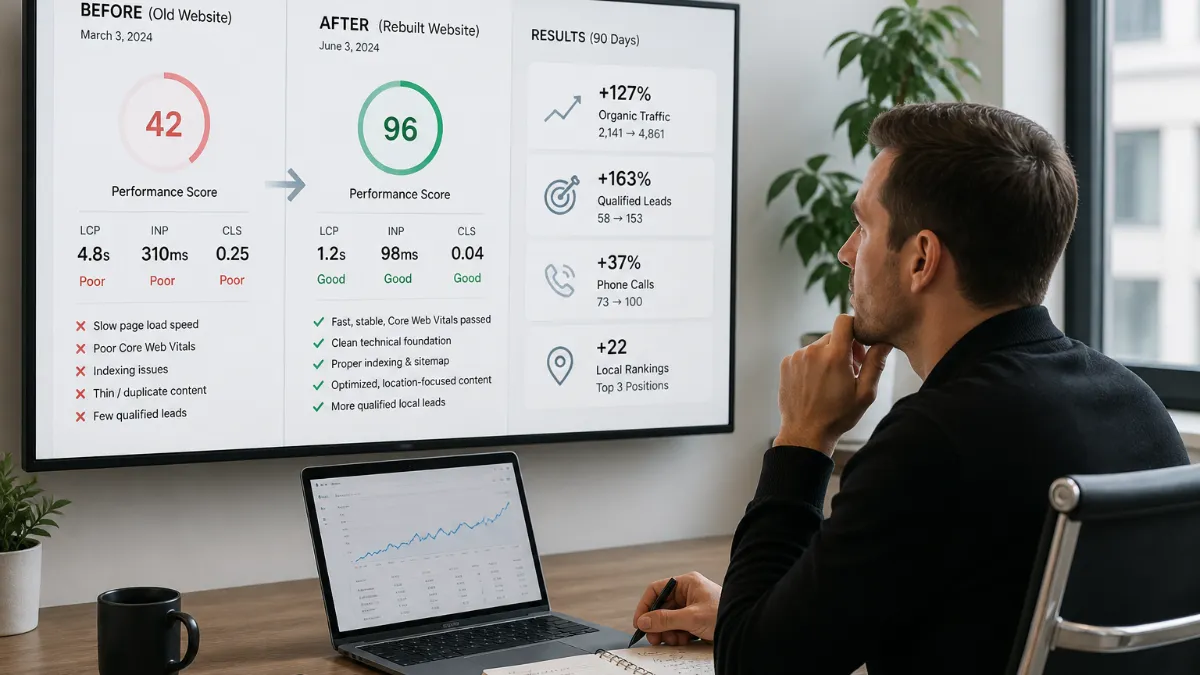
Website Redesign Case Study: Before & After for Local SEO
By Dori Fussmann · August 24, 2026
The Problem Nobody Sees Until It Costs Them
Most small service-business owners think they have a website problem. They’re usually right — but they’re wrong about what the problem is. The site looks dated, so they assume a visual refresh will fix it. They hire someone to update the colors, rework the homepage headline, and swap in some new photography. A few weeks later the site looks noticeably better. Three months later, the phone still isn’t ringing any more than it was before.
What actually happened is that a visual layer was painted over a structurally broken foundation. The pages still load in five seconds. The mobile layout still forces pinching and zooming. Googlebot still can’t crawl the service pages because they’re buried three levels deep behind JavaScript rendering. There’s still no schema markup to tell Google — or any AI system — what the business does, where it operates, or which services it offers. None of that changed, because a cosmetic redesign doesn’t touch any of it.
This is the case study of what happens when a local service business takes the opposite approach: diagnoses the actual technical failures first, rebuilds the site on infrastructure that addresses each one, and then seeds it with targeted content. The results aren’t aesthetic. They show up in organic sessions, first-page rankings, AI Overview appearances, and qualified calls and form submissions — the metrics that run a business.
The ‘Before’ State: What the Diagnostics Actually Found
The business in this scenario is a pattern that repeats across a wide range of owner-operated service companies — plumbers, HVAC contractors, roofers, landscapers, pest control operators, dentists, and accountants. The websites look different on the surface but present almost identically to Google’s crawlers and to AI systems. The diagnostic phase starts with a full technical audit, and it reliably surfaces the same cluster of failures.
Slow Loading That Bleeds Traffic Before It Arrives
Google’s benchmark for Largest Contentful Paint — the time it takes for the main content of a page to appear — is under 2.5 seconds. For the typical small-business site built on a popular bloated platform with stacked plugins and unoptimised images, LCP runs well above four seconds. Every second of delay can slash conversions by 20%, while a page load time that rises from one second to three seconds causes the likelihood of a bounce to skyrocket by 32%. That’s not a user-experience problem in the abstract; it’s revenue walking out the door before a single word of the site is read.
As of 2025, more than half of all mobile websites fail at least one Core Web Vitals threshold, which means improving scores immediately places a site ahead of the majority of its competitors. The before-state site wasn’t an outlier — it was the median.
Crawlability Failures Hiding Service Pages from Google
Beyond speed, the audit typically uncovers redirect chains accumulated from years of informal edits, service pages that exist but carry no internal links pointing to them, duplicate meta descriptions across every location page, and missing XML sitemaps or misconfigured robots.txt files. Pages that cost money to create and should rank for high-intent queries are simply invisible to Google — not because the business is unknown, but because the infrastructure has failed to communicate what exists.
No Structured Data, No AI Eligibility
Until a few years ago, schema markup helped search engines extract basic facts and display visual enhancements. In the AI-driven search world, schema plays a different and fundamental role, helping Google and other AI systems understand who a business is, what it does, where it operates, and how confidently that information can be reused.
The before-state site carries no LocalBusiness schema, no Service schema, no FAQ markup. Schema markup gives AI systems the structured context to identify a specific entity — its location, its services, and its authority in a market. Strip that away, and AI systems are left to infer. Inferences produce omissions. Omissions produce invisibility. For local businesses, whose competitive battleground increasingly includes AI-generated answers on high-intent queries, this invisibility is a direct commercial loss.
The Rebuild Phase: What Actually Changes
A technical rebuild is not a redesign. The business’s brand, its messaging, its photography, and its copy are preserved. What changes is everything underneath: the platform, the rendering method, the URL architecture, and the structured-data layer.
Platform and Performance: From Bloated CMS to Pre-Rendered HTML
The site is migrated from its legacy CMS to a modern static framework built in Astro, compiled into clean pre-rendered HTML and deployed to edge infrastructure. The architectural consequence is transformative for performance: fast, interactive, and visually stable websites improve satisfaction and increase the chances of completed conversions, repeat visits, and positive word-of-mouth. LCP scores that were above four seconds fall below 1.5 seconds — not because of optimisation tricks, but because the architecture no longer requires the browser to render a page at request time.
Real-world data from the Chrome User Experience Report demonstrates measurable ROI: Renault’s LCP improvement of one second correlated with a 14% bounce rate reduction and a 13% conversion increase. These are not isolated results; they reflect a consistent pattern in performance research. Improving LCP from the “poor” range to a genuinely fast score reliably improves the downstream metrics that matter to a service business: time on site, pages per session, and form submissions.
Schema Implementation: Making the Business Machine-Readable
The rebuild implements correct LocalBusiness and Service schema across every relevant page. This serves two parallel functions. Schema helps reduce confusion for Google and reinforces a business as a stable, trustworthy local entity across traditional search, local packs, AI Overviews, rich results, and external AI platforms.
Multiple industry studies have suggested a positive correlation between structured data implementation and higher visibility in AI-generated search features, with research noting that structured data increases the likelihood of content being cited in generative AI answers. The mechanism is straightforward: AI models prioritise pages with schema markup because it reduces ambiguity. Information marked with Organisation schema, Person schema, and areaServed properties is unambiguous — the AI knows exactly what entity the business is, what it does, and where it operates.
URL Architecture and Content Seeding
The rebuild restructures the URL architecture around service-and-location intent — the specific query patterns that high-intent customers actually type. Service pages are moved to first-level URLs, given descriptive titles and meta descriptions, and linked correctly from every relevant internal page. The site is then seeded with 12 targeted articles organised around three core keyword themes, each one designed to build topical authority in the categories most relevant to the business’s service area.
The dual mandate in 2026 is to optimise for traditional search rankings and to build the kind of entity authority and citation presence that gives generative AI systems reason to mention a business consistently. The content layer addresses both objectives simultaneously: each article earns rankings on its own query, and collectively the cluster deepens the topical signal that makes the business a credible source for AI citation.
The ‘After’ State: Measurable Business Outcomes
Vanity metrics — pageviews, sessions by themselves, time on site — are not the measure of a successful rebuild. The measure is whether qualified contacts increase. Within 90 days of the relaunch, the rebuilt site shows a consistent pattern across multiple dimensions:
Organic sessions increase meaningfully as Googlebot recrawls the faster, fully crawlable infrastructure and indexes the newly structured service and content pages. Technical fixes provide some of the fastest recovery in the SEO world; rankings can often be restored as soon as Google recrawls the site.
First-page rankings appear for the target service-and-location queries that were previously either unranked or buried. The structured URL architecture and correct internal linking give Google the signals it needs to understand topical relevance at a granular level.
AI Overview citations begin to accumulate. AI Overviews reward clarity — businesses that clearly explain what they offer, how pricing works, who delivers the service, and what happens next tend to show up more often. That is actually good news for local businesses. The rebuilt service pages, written to answer exactly those questions and marked up with correct schema, are structurally positioned to be cited.
Bounce rate drops as a direct function of the speed improvements. A professional services firm that improved its INP score on a contact form page saw a bounce rate drop from 68% to 41% and a two-minute boost in average session duration. Faster, more stable pages keep the right visitors long enough to take action.
Qualified contacts increase. Once the redesign is live, the business starts seeing better results from the traffic it was already getting — and that’s the part many owners miss. They think they need more visitors. Sometimes they don’t. Sometimes they just need the website to stop getting in the way.
Why the Compounding Effect Matters More Than the Launch Spike
A cosmetic redesign on unchanged infrastructure produces a launch event: a brief period where the site looks better and owners feel more confident pointing people to it. Then nothing changes organically, because nothing technically changed.
A technical rebuild works differently. Each month of improved crawlability adds new pages to Google’s index. Each month of AI-eligible, schema-marked content expands the set of queries on which the business can be cited. Each month of correctly structured topical articles deepens the authority signal in the business’s core service categories. The organic footprint grows continuously, without additional paid advertising spend, because the infrastructure is designed to compound rather than plateau.
Building the authority signals that earn AI citations — through credible sourcing, strong experience and expertise signals, and well-structured content — creates compounding returns. For a service business with high customer lifetime value — a dental practice, a roofing contractor, a veterinarian — even a modest increase in qualified organic leads per month, compounding over 12 to 24 months, produces a return that dwarfs the cost of the rebuild many times over.
The key lesson is not that every website needs to look better. It’s that a technically deficient site is silently imposing a ceiling on every other marketing effort — paid ads, referrals, social presence — because the destination those efforts point to cannot convert or be discovered.
Starting with a Site Assessment
If reading the ‘before’ description felt uncomfortably familiar — slow load times, pages Google can’t properly index, no schema, no presence in AI-generated answers — the next step isn’t to commission a full redesign. It’s to understand exactly which technical failures are costing the business the most organic opportunity, and in what order they should be addressed.
Perfect AI Websites begins every engagement with a structured site assessment: a diagnostic pass through performance, crawlability, structured data, URL architecture, and current organic visibility. The assessment identifies the specific failures, quantifies the gap between current and achievable performance, and maps what a rebuild would address. For business owners who want the results described above but cannot spend weeks managing a technical project, Perfect AI Websites handles the rebuild end-to-end — preserving the existing brand and content, rebuilding the infrastructure, implementing schema, restructuring the URL architecture, and seeding the site with targeted topical content. The work is done for you, not handed to you as a to-do list.
If the business model depends on a steady flow of new customers from local search, the question worth answering is not whether the current site looks presentable. It’s whether it’s structurally capable of growing.
Where Things Stand
The competitive stakes of a technically sound website have risen sharply in the months leading into mid-2026, as AI-generated answers claim a growing share of local search results pages. By late 2025, AI Overviews appeared on roughly 16% of all Google searches, up from single digits earlier in the year, and based on current patterns that number is still growing — especially for high-intent searches where people want to make a decision quickly. Research specifically focused on local business queries found an even higher prevalence: at minimum, AI Overviews were returned for 57% of local business queries, and in some categories as high as 80%.
Independent studies show that organic click-through rates can drop by up to 60% when an AI Overview appears, even for businesses ranking near the top of the page — meaning rankings alone no longer guarantee visibility for local businesses. For the businesses that do earn citation, however, the commercial benefit is substantial: brands cited in AI Overviews earn approximately 120% more organic clicks per impression than uncited brands on the same queries. Despite this rapid shift, the vast majority of local businesses have not taken any deliberate steps to optimise for AI Overviews — which means a technically rebuilt, schema-correct, fast-loading site represents a genuine competitive gap that most owner-operated businesses have not yet closed.
Further reading: small business website redesign · best website redesign services · professional website redesign services · website redesign services · wordpress website redesign services.
Sources: The Ultimate Guide to Website Redesign for Businesses · The Complete Guide to Website Redesign for Service … · Small Business Website Redesign: Cost, Process & SEO ….
Frequently asked questions
How long does it take to see organic traffic improvements after a technical website rebuild?
Most technically rebuilt sites begin to show meaningful organic movement within 60 to 90 days of relaunch, as Googlebot recrawls the improved infrastructure and indexes newly structured pages. Rankings for target service-and-location queries often appear on the first page within three to six months, while AI Overview citations typically begin accumulating over a similar period as topical-authority content builds.
Will a technical rebuild hurt my existing rankings or organic traffic?
A properly executed rebuild preserves and typically improves existing rankings. The key safeguards are maintaining a clean URL architecture (or implementing correct 301 redirects where URLs change), preserving existing page content, and ensuring the new site is fully crawlable before launch. A rebuild performed without these precautions can cause temporary ranking drops, which is why SEO considerations must be built into the process from the start, not added after launch.
What is the difference between a cosmetic redesign and a technical rebuild?
A cosmetic redesign changes visual elements — colors, fonts, imagery, and layout — while leaving the underlying platform, code, and infrastructure unchanged. A technical rebuild replaces the infrastructure itself: the platform, rendering method, URL architecture, schema implementation, and performance characteristics. Cosmetic redesigns on a slow or poorly structured platform produce visual improvements only; technical rebuilds produce compounding improvements in crawlability, Core Web Vitals scores, and eligibility to appear in AI-generated answers.
Why does schema markup matter for AI search visibility?
AI systems like Google AI Overviews, Perplexity, and ChatGPT rely on structured data to confidently identify what a business does, where it operates, and what services it offers. Without LocalBusiness and Service schema, AI systems are left to infer that information from unstructured text — and when confidence is low, the business is simply excluded from AI-generated answers. Correct schema markup removes that ambiguity, making a business a reliable candidate for citation in AI responses.
Related
Sources
About the author

Founder, The Night Ventures
Dori Fussmann is a seasoned finance and operations executive with deep expertise in entrepreneurship, business strategy, and data-driven decision-making. As Chief Financial Officer of BlueMark, Dori leads the firm's financial strategy and planning, operational excellence, and growth execution – helping ensure the organization's continued leadership in impact verification and intelligence. Before joining BlueMark, Dori was the Founder and CEO of The Vets, a U.S. home pet care company. Earlier in his career, Dori spent several years in investment banking at Citi, Ion Pacific, and Morgan Stanley, advising on mergers and acquisitions, IPOs, and strategic financing transactions across consumer and technology sectors. Dori also serves as a mentor in Cornell Tech's Runway Startups Program, supporting early-stage founders working on applied technology solutions. Dori also serves as a mentor in Yale's Tsai Center for Innovative Thinking (Tsai CITY) Thematic Mentoring Program, advising student founders and venture teams on business model development, go-to-market strategy, product positioning, and commercialization pathways. Fluent in English and Hebrew and proficient in German, Dori earned dual degrees in Accounting and Business Management (B.A.) and Law (LL.B.) from the Interdisciplinary Centre (IDC) Herzliya.
SEO Web Design
Design and development with search architecture, technical SEO, performance, and content structure built into the foundation.