SEO Audit Tool vs. Pro Service: What Small Businesses Need
By Dori Fussmann · August 24, 2026
The Tool Will Tell You What’s Broken. It Won’t Tell You What to Do About It.
Every small business owner who has ever typed their URL into a free SEO checker has experienced the same moment: a list of dozens — sometimes hundreds — of flagged issues appears on the screen, color-coded red, orange, and green, with a score somewhere out of 100. It feels like progress. It looks like insight. And then comes the paralysis of not knowing which item on that list actually matters for a plumbing company in suburban Ohio, or a veterinary clinic trying to show up in “vet near me” searches.
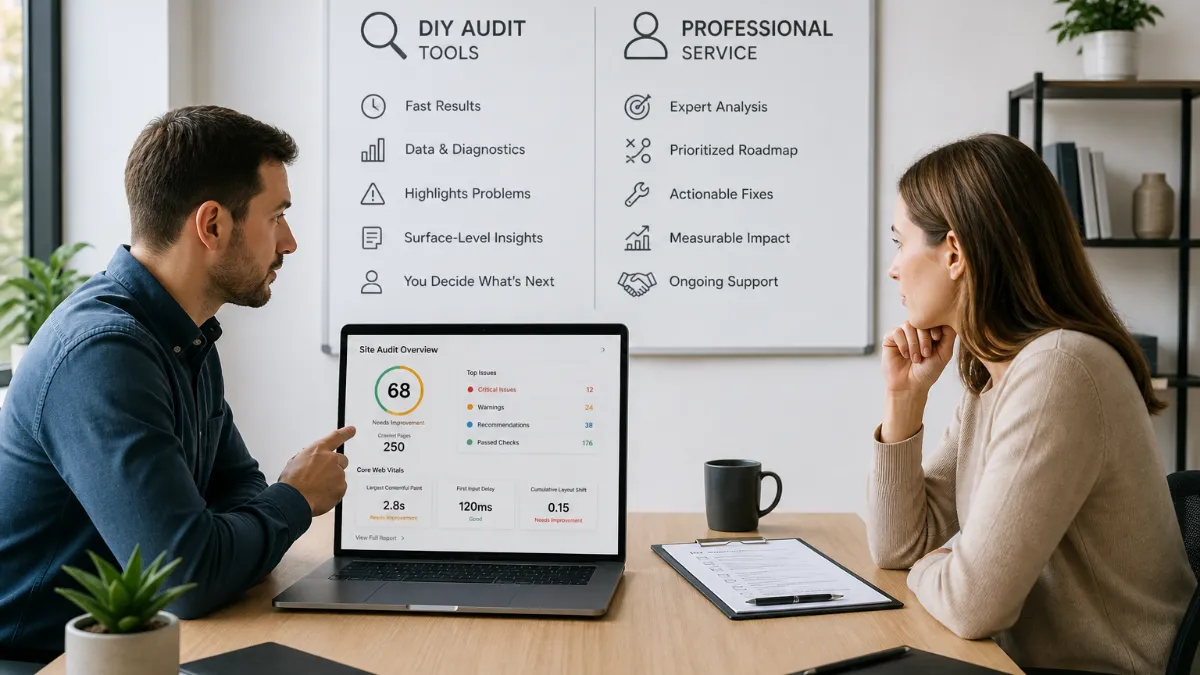
This is the central tension in the SEO site audit tool vs. professional service debate, and it rarely gets framed honestly. The tools are genuinely powerful. The problem is that their output is not the same thing as a decision. Understanding that distinction — and knowing which option your business actually needs — can save you months of wasted effort and a subscription you don’t need.
What Free SEO Audit Tools Do Well (and Where They Stop)
Google Search Console provides indexing and performance data directly from Google, reporting on coverage issues, manual actions, mobile usability signals, Core Web Vitals, clicks, and impressions. It is the most honest feedback loop available on the web, because the data comes straight from the search engine itself. The free version of Screaming Frog crawls up to 500 URLs, making it suitable for smaller websites or specific page analyses, and excels at identifying technical issues like broken links, duplicate content, and missing meta tags — with its strength lying in comprehensive crawl data and export capabilities.
Together, these two free tools cover the essential diagnostic ground for most small business websites. For most small sites, the free combination of Google Search Console plus Screaming Frog’s free tier covers the essential bases. The catch is what happens after the data appears. Free tools are good at finding symptoms but weaker at deciding what deserves attention first — a missing meta description on a low-value archive page is not the same as an indexing problem on a primary service page.
This is not a flaw in the tools. It is a fundamental limit of what automated software can deliver without business context. A crawler does not know that your “emergency HVAC repair” page generates 80 percent of your revenue leads. It flags that page’s missing H1 with the same severity as a missing H1 on your privacy policy.
What Paid SaaS Audit Tools Add — and What They Still Can’t Do
SEO audits in 2026 are no longer manual checklists; they are AI-augmented diagnostics that surface issues before traffic slips, and choosing the right SEO audit tools now determines how quickly you detect crawl gaps, fix on-page weaknesses, and improve Core Web Vitals. Paid platforms like Semrush, Ahrefs, and Sitebulb make that detection faster and richer. Semrush Site Audit combines technical analysis with content recommendations and competitive insights, with its unique selling proposition being the integration of audit data with advertising intelligence — providing prioritized task lists and tracking audit score improvements over time.
Sitebulb combines crawling with visual issue grouping, highlighting structural patterns and helping teams communicate technical findings clearly. These are genuinely useful capabilities. Competitor gap analysis, historical trend data across multiple crawl cycles, automated scheduling — these features move the needle meaningfully for teams that have the expertise to act on them.
But here is what paid tool vendors never put in their marketing: practitioners in technical SEO discussions have noted that automated tools provide “a thread to start pulling” about 90 percent of the time, not a complete diagnosis, especially as site complexity grows. A $120-per-month subscription gives you a richer thread. It does not give you a strategist. Several agency-focused resources note that many expensive audits are essentially PDFs exported from standard crawling software, so businesses should choose services that offer manual review and prioritized, actionable recommendations rather than raw data dumps.
For a single small-business website with under 50 pages, the math rarely works in the paid tool’s favor. Analysis of 1,000+ SEO professionals reveals that enterprises typically use 5–7 different tools for comprehensive audits, while smaller businesses often succeed with 2–3 carefully chosen platforms. Paying enterprise-tier subscription prices for a 30-page local service website is almost always a mismatch between tool scale and site scale.
What a Professional Service Actually Delivers
A professional audit service is not a fancier version of a tool. It is a different category of deliverable entirely. Where a tool returns a weighted list of technical flags, a professional reviewer returns a filtered, sequenced action plan built around your specific business situation.
For small businesses, the real value comes from connecting audit findings to visibility, qualified inquiries, content direction, and technical implementation. That connection requires knowledge that no crawler possesses: which service generates the highest customer lifetime value for your business, how your local competitors are positioned, what search intent your best customers actually have when they hit Google, and which technical fixes will move revenue versus which will merely improve a score.
Coverage from an experienced specialist goes beyond what automated tools can provide — including competitive backlink analysis, keyword research, content gap assessment, and expert prioritization. The output is not a spreadsheet. It is a ranked sequence of actions tied to business outcomes, with the reasoning explained so an owner can understand not just what to fix but why that fix matters before the next one.
If you have developers and content writers on staff, a one-time professional audit may be enough; if you do not have that team, a static report becomes shelfware. This is the honest question to ask before spending on any audit — tool or service: who is actually going to implement the findings, and do they have enough context to do it in the right order?
The Question Tools Cannot Answer: Is the Infrastructure the Problem?
This is the point in the comparison that tool vendors have no incentive to surface, but it is the most consequential one for small business owners with older sites. When a tool flags that a page is slow, it gives you a score and a list of contributing factors — unoptimized images, render-blocking scripts, large layout shifts. What it cannot tell you is why those problems exist at the structural level. A professional reviewer can. And sometimes, the answer changes everything.
Many small business websites are built on popular drag-and-drop page builders — platforms that generate bloated, poorly structured HTML, resist meaningful performance optimization at the page level, and produce URL structures and internal linking patterns that make it difficult for search engines to establish topical relevance. When a site is built on that kind of foundation, no sequence of individual fixes will get it to where it needs to be. The audit findings are symptoms. The platform is the disease.
Three years ago, an SEO audit might have focused on keyword rankings and backlinks. Today, the priorities are different — search engines reward fast, accessible, trustworthy websites, and AI systems prioritize clear structure, topical authority, and answer-friendly content. A page-builder site can be patched on the content side, but its underlying architecture — how it loads, how it is crawled, how its structure is read by both Google and AI discovery systems — often cannot be meaningfully improved without changing the platform itself.
A tool will tell you the page scored 47 out of 100 on performance. A professional reviewer will tell you the page scored 47 because the platform generates 600KB of unused JavaScript on every page load, and the practical remediation path is a rebuild, not a plugin. That is a fundamentally different conversation, and it changes every downstream decision about time, budget, and effort.
The Sweet Spot for Most Small Local Businesses
For a local service business — a landscaper, a dentist, an HVAC contractor, a pest control company — with a site under 50 pages, the optimal approach is almost never a paid SaaS subscription running indefinitely. If you have a small site under 50 pages, basic technical knowledge, and budget constraints, a DIY audit using Google Search Console and a free crawling tool can find obvious errors.
From there, the valuable next step is a one-time professional review that translates the raw tool data into a sequenced fix list with business context attached. That engagement answers the question the tools cannot: given your site, your market, and your customer, what should happen first, what can wait, and is there a structural problem that no amount of iterative fixing will resolve?
This distinction matters most for small businesses — if your team cannot run crawls, assign developer tickets, validate fixes, and then monitor for regressions, a tool alone often creates more backlog than progress, and that is the difference between an audit that sits in a shared folder and an audit that improves search performance.
The ongoing paid tool subscription earns its keep for agencies managing dozens of client sites, for in-house teams running recurring crawls across large site inventories, and for businesses with the technical depth to act on trend data across multiple crawl cycles. For a single-location service business with a modest web presence, that monthly cost is almost always better allocated to implementation than to data generation.
When the Audit Keeps Pointing at the Same Problem
There is a category of small business website where the audit-and-fix cycle breaks down entirely. Run the audit, fix the flagged items, run it again six months later — and the same categories of issues have reappeared, or new ones have surfaced in the same structural locations. Performance is still poor. Crawl depth is still shallow. The site still does not rank for the service-area terms the business depends on.
This pattern is a signal. When audit results consistently point to infrastructure — not content, not links, not on-page optimization — the right response is not a better tool or a more thorough service engagement. It is a rebuild on infrastructure that does not have those problems built into its foundation.
That is the logic behind Perfect AI Websites’ approach. Rather than delivering an audit report and leaving the implementation to the business owner, the work is to rebuild the site itself — in modern, fast, crawlable infrastructure — so that the class of technical findings that keep reappearing never accumulates again. The audit’s conclusions become the architectural brief, not a to-do list. Customers who have watched their audit scores stay stubbornly low despite repeated fixes often find this framing clarifying: the problem was never that they lacked information about what was wrong. It was that the platform underneath the site could not be fixed from the outside, only replaced. If your SEO audit tool keeps identifying the same infrastructure problems, it may be time to ask whether the right answer is a better report — or a better foundation.
Where Things Stand
The SEO audit tool market remains active and is evolving rapidly in mid-2026, with a notable shift toward AI-assisted discovery layered on top of traditional technical crawling. AI SEO audit tools now handle approximately 44% of SEO tasks, and founders, marketers, and agencies are dealing with an AI-driven search world where visibility increasingly includes platforms like ChatGPT and Perplexity — not just Google. Recent data from audits run across more than 100,000 websites between January and July 2026 shows that the median site scores 71 out of 100 — a C+ — with only about 7% earning an A grade , suggesting that most small business sites still have substantial room for technical improvement. Pricing figures as of July 2026 show a proliferating range of tool tiers , with new entrants offering AI-scored visibility checks alongside traditional crawl data — a sign that the market is responding to the reality that Google’s AI Overviews and other AI search surfaces now require a separate optimization discipline from classic technical SEO. For small business owners, this means the choice between a tool and a professional service is becoming more nuanced, not less: the audit stack required to cover both traditional search and AI discovery has expanded, reinforcing the case for expert guidance over DIY tool stacking.
Further reading: technical SEO audit · how to conduct a technical seo site audit · seo site audit cost · seo site audit · what is seo site audit.
Sources: Free SEO Checker: Check for SEO & AI Search Issues · Free SEO Audit Tool — 172 Checks + AI Visibility · Website Audit Tool: Automated SEO Audit ⚙ 115+ Checks.
Frequently asked questions
Can a free SEO audit tool replace a professional audit for a small business?
For a simple site under 50 pages, free tools like Google Search Console and the free tier of Screaming Frog can surface most mechanical errors — broken links, missing tags, slow pages. But free tools return unweighted data with no business context. They cannot tell you which issues matter most for your specific customer journey, competitive landscape, or revenue goals. A professional review adds that prioritization layer, turning a list of flags into a sequenced action plan. For the majority of small local businesses, the ideal approach is using free tools for initial discovery and then investing in a one-time professional review rather than an ongoing paid subscription.
What does a paid SaaS audit tool give you that free tools don't?
Paid platforms add meaningful depth: competitor gap analysis, historical trend data across crawls, automated scheduling, and polished reporting. They can show you how your technical health is trending over time and where rivals are outranking you on specific keywords. The trade-off is that they still deliver data rather than decisions — a business owner without SEO expertise must still interpret and sequence the output. For a single small-business site, the monthly subscription cost rarely pays for itself compared to combining free tools with a focused one-time professional engagement.
How is a professional audit service different from running an audit tool?
A professional audit service replaces tool output with expert judgment. Findings are filtered through your business model, your local competitive landscape, and your customer journey — not just flagged against a generic checklist. The deliverable is a prioritized action plan, not a list of unweighted errors. Crucially, a professional reviewer can identify when an issue points to a root infrastructure problem — such as a page-builder platform that cannot be meaningfully optimized without a rebuild — which changes the entire remediation strategy.
When does it make more sense to rebuild a site than to keep fixing audit findings?
When audit reports consistently point to the same structural or infrastructure problems — slow load times caused by bloated page-builder code, poor crawlability baked into the CMS architecture, or a flat site structure that makes topical authority impossible — incremental fixes reach a ceiling. Each audit cycle surfaces the same category of issue because the root cause is the platform, not the content. In those cases, rebuilding on modern, performant infrastructure eliminates the entire class of recurring findings rather than treating symptoms one at a time.
Related
Sources
About the author

Founder, The Night Ventures
Dori Fussmann is a seasoned finance and operations executive with deep expertise in entrepreneurship, business strategy, and data-driven decision-making. As Chief Financial Officer of BlueMark, Dori leads the firm's financial strategy and planning, operational excellence, and growth execution – helping ensure the organization's continued leadership in impact verification and intelligence. Before joining BlueMark, Dori was the Founder and CEO of The Vets, a U.S. home pet care company. Earlier in his career, Dori spent several years in investment banking at Citi, Ion Pacific, and Morgan Stanley, advising on mergers and acquisitions, IPOs, and strategic financing transactions across consumer and technology sectors. Dori also serves as a mentor in Cornell Tech's Runway Startups Program, supporting early-stage founders working on applied technology solutions. Dori also serves as a mentor in Yale's Tsai Center for Innovative Thinking (Tsai CITY) Thematic Mentoring Program, advising student founders and venture teams on business model development, go-to-market strategy, product positioning, and commercialization pathways. Fluent in English and Hebrew and proficient in German, Dori earned dual degrees in Accounting and Business Management (B.A.) and Law (LL.B.) from the Interdisciplinary Centre (IDC) Herzliya.
SEO Web Design
Design and development with search architecture, technical SEO, performance, and content structure built into the foundation.